
Peyronie’s disease
Peyronie’s disease is a non-cancerous condition of penis which mostly affects men above 40 years of age. Peyronie’s disease can lead to formation of hard plaques in penis, erectile dysfunction and penile curvature.
Congenial penile curvature is different from Peyronie’s disease. Congenital penile curvature is usually by birth, but most men with congenital penile curvature first notice the bending of the penis (penile curvature) after puberty when they start noticing their penile erections.
Peyronie’s disease was first observed by Fallopius and Vesalius in 1561, but it was not until 1743 that the disease was fully described by Francois Gigot de la Peyronie. This is not a sexually transmitted disease. This develops due to microtrauma and abnormal wound healing in penis although the exact cause is not known.
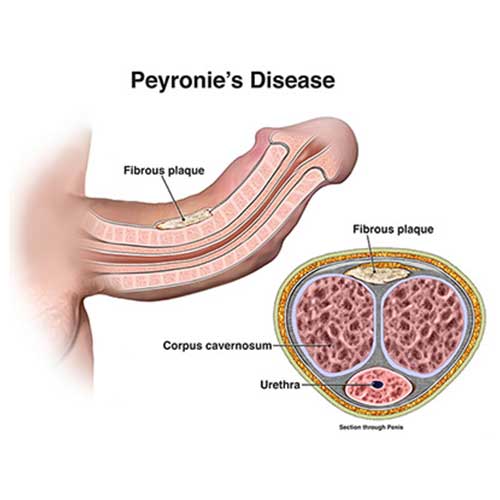
Peyronie’s disease has two phases: acute (initial) and chronic (stable).
The initial acute phase lasts from 3 months to 12 months which is usually associated with pain. Penile curvature and plaques (nodules) start to appear in penis in this phase.
The chronic stable phase is when the disease stabilizes. It may lead to erectile dysfunction, stabilization of curvature and formation of hard calcified plaques in penis.
Penile doppler scan with a penile injection will usually reveal the site of plaque and degree of curvature.
What are the causes for hard rock-like lump in penis?
Depending on the family history, risk factors and circumcision status, the hard lump on the penis could be Peyronie’s disease or Penile cancer. Early consultation with an expert andrologist will confirm the diagnosis to initiate early treatment.
Does Peyronie’s disease go away?
Peyronie’s disease can lead to hard nodules (plaque), erectile dysfunction, and bending of the penis (penile curvature). A study from New York revealed that out of the 246 men with peyronie’s disease and bent penis (penile curvature), only 12% had some improvement, 40% remained stable and 48% had worsened (Mulhall J et al, 2006). So 88% of men with Peyronie’s disease will NOT see spontaneous improvement. Hence requires early and prompt evaluation.
Is Peyronie’s disease harmful or dangerous?
Peyronie’s disease per se will not endanger the life but can lead to very unsatisfactory sexual life which in turn can lead to strained relationships and depression.
Treatment options:
- Watchful waiting and follow-up
- Oral medications
- Penile traction devices
- Penile injections
- Penile plication
- Plaque incision / excision and grafting surgery
- Penile implant surgery
Is there a pill for Peyronie’s disease?
Pills are usually prescribed in the initial painful acute phase to reduce pain and assist in better healing or scar remodeling inside the penis. No pill can cure peyronie’s disease.
Which is the best treatment for Peyronie’s disease at home?
Penile traction therapy is a device which the patient himself can use at home to correct the penile curvature to an extent which facilitates comfortable vaginal penetration. Dr Pramod Krishnappa has extensive experience in penile traction devices and has published the results of a novel Penimaster PRO penile traction therapy in British Journal of Urology-International (BUI 2018) [PMID: 30365247] during his fellowship in Spain.
What are the injection therapies available for peyronie’s disease ? Is collagenase (Xiapex / Xiaflex) available in India ?
Collagenase injection is very expensive and currently available only in the United States of America (USA) [last update April 2023], it was withdrawn from Europe in Nov 2019 due to unknown reasons. Verapamil injections can be tried but is not followed at most centres due to poor outcomes when compared to collagenase injections. Interferon injections are almost given worldwide for the treatment of peyronie’s disease. Please refer to the article published by Dr Pramod Krishnappa in Sexual Medicine Reviews 2022: “Penile Modeling in Peyronie's Disease: A Systematic Review of the Literature”
Can vacuum device help in Peyronie’s disease ?
There are only two good quality studies highlighting the role of vacuum device in Peyronie’s disease . Both studies have reported very dismal satisfaction rates of only around 51%.
Is surgery safe for Peyronie’s disease?
Surgery is done when the penile curvature is too severe (more than 30 degrees) or when erectile dysfunction is too severe, and not responding to all non-surgical treatments or both. Various surgeries include penile plication, plaque incision grafting and penile implant surgery. Combined penile curvature correction and penile implant surgery can be done in same sitting for better results. Dr Pramod Krishnappa has published a detailed review article on “Surgical Management of Peyronie's Disease with Co-Existent Erectile Dysfunction” in Sexual Medicine Open Access Journal 2019.
Who is the best doctor for Peyronie’s disease?
Dr Pramod Krishnappa is the best andrologist dealing with Men’s’ Sexual Health and Male Fertility. He has been trained extensively in high volume Andrology centres in Madrid (Spain), Belgrade, Budapest, Chicago, and New York. It is preferable to consult a urologist who is exclusively trained or specialized in Andrology to seek treatment for Peyronie’s disease.
Dr Pramod Krishnappa is one of the very few andrologists of India to have published maximum number of research papers on Peyronie’s disease.
Frequently Asked Questions
Peyronie’s disease usually develops after previously normal penile development and is associated with scar tissue or plaques, whereas congenital curvature is generally present from birth. A specialist assessment can distinguish the two and guide appropriate Peyronie’s disease treatment.
Not necessarily. A hard lump can be associated with Peyronie’s disease, but other conditions, including penile cancer, can also produce a lump. An early examination by an experienced specialist is therefore important for accurate Peyronie’s disease diagnosis.
The acute phase generally occurs during the first several months and may involve penile pain along with the development of plaques and curvature. The condition can later enter a stable phase where the curvature and plaque become more established, making acute Peyronie’s disease evaluation useful before the condition progresses.
Yes. Pain often occurs during the active phase, while the later stable phase may involve persistent curvature, hard or calcified plaques, and erectile difficulties. The absence of pain does not necessarily mean the underlying Peyronie’s disease progression has stopped.
A penile Doppler scan with an appropriate penile injection can help identify the plaque and assess the degree of curvature. This information can help the specialist understand the condition and select an appropriate Peyronie’s disease evaluation pathway.
Penile traction therapy is a non-surgical option that can be used by the patient at home and may help correct curvature to an extent that facilitates comfortable vaginal penetration. Its suitability and expected benefit should be assessed individually as part of penile traction therapy.
No. Non-surgical management can include observation and follow-up, oral medication for pain during the acute phase, penile traction devices, and selected injection therapies. The appropriate non-surgical Peyronie’s treatment depends on the stage and characteristics of the condition.
Yes. The condition can be associated with erectile dysfunction, particularly during the chronic stable phase. When curvature and erection difficulties occur together, the specialist may need to address both problems while planning Peyronie’s disease and erectile dysfunction treatment.
For selected men with severe curvature or significant ED that has not responded to non-surgical approaches, surgical options can include penile plication, plaque incision with grafting, or penile implant surgery. In some cases, curvature correction and an implant can be performed during the same procedure as part of Peyronie’s disease surgery.
Waiting without medical assessment may not always be advisable because spontaneous improvement is uncommon according to the study cited on the page. An early specialist consultation can establish the diagnosis, stage the condition, and determine whether observation or active Peyronie’s disease management is appropriate.