
Penile Implant Surgery
Penile implant surgery is done for erectile dysfunction, peyronie’s disease and priapism (delayed presentation) after the initial medical therapy fails to improve the condition.
There are broadly two types of penile implants: malleable (semirigid) and inflatable.
What are the differences between malleable (semirigid) and inflatable penile implants?
| Malleable (semirigid) | Inflatable |
|---|---|
| Penis will always remain in erect position, but the person can easily conceal the implant by bending it down. | He gets an erection only when he wants it, by pressing a pump in scrotum. Simulates natural erection. |
| Less expensive | Expensive |
| Patient Satisfaction: 70-80% | Patient Satisfaction >90% |
| Mechanical failure unlikely | 10-year mechanical survival of implant: 80% |
| Men with hand tremors can use | Men with hand tremors may find it difficult to use |
| Not covered by insurance in India | Not covered by insurance in India |
| Moderate level of expertise of surgeon is required | High level training of surgeon is required |
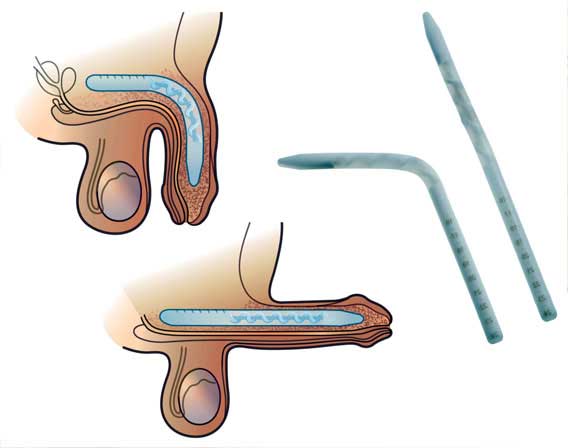
Semirigid penile implant
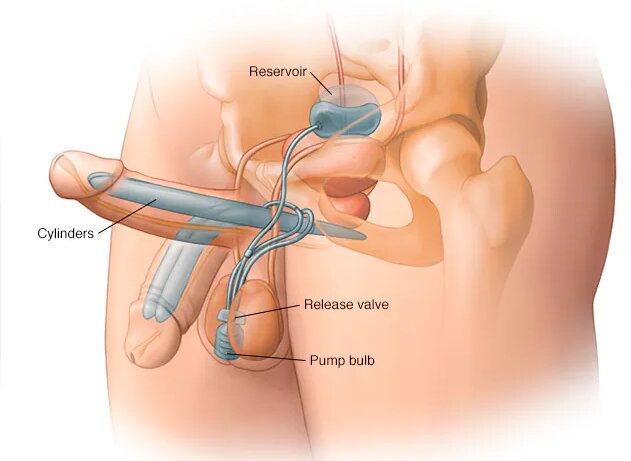
Inflatable penile implant
How long do penile implants last?
Majority of the semirigid and inflatable penile implants usually last for 15 years unless there is an infection which is not improving with antibiotics.
Does penile implant increase penis size?
Penile implants are designed to provide an erect penis which is hard enough for vaginal or anal penetration during sex. It is not designed to improve penis size or libido or ejaculation.
Can a woman tell if the man has penile implant?
It depends to what extent a woman explores your penis during foreplay. Most women would be able to notice a semirigid penile implant but may not be so with an inflatable implant. It is always better you reveal the history of penile implant surgery to your partner as most women would be OK with it.
Can cancer patients undergo penile implant surgery?
Yes, many men after surgery or radiotherapy for pelvic cancers such as prostate cancer, bladder cancer and colon cancer develop erectile dysfunction which may not respond to medical therapy. Such patients can safely undergo penile implant surgery for better quality of life.
Does a penile implant improve fertility?
Penile implant may indirectly improve fertility outcomes by reducing performance anxiety and to bring back confidence in men leading to higher frequency of sexual intercourse in a month thereby increasing the chances of conception. Penile implant surgery will not result in improvement of semen parameters.
What is the best age for penile implant?
There is no specific age limit for penile implant surgery. As young as a 21-year-old with micropenis may undergo penile implant surgery after neophallus reconstruction. Dr Pramod has placed penile implant in a 92-year-old gentleman who had a 45-year-old girlfriend for a satisfactory sexual life. Age is just a number.
Can I pee with penile implant?
Yes, urinary passage (urethra) is untouched during penile implant surgery. Those who are already on medications for prostate enlargement should continue their medications after penile implant surgery.
How painful is a penile implant?
During the surgery, it will be completely painless as the surgery will be done under anesthesia. Post-operatively, there will be some discomfort or mild-moderate pain depending on patient’s pain threshold capacity. Most men would be comfortable after 3-4 days after surgery. Adequate pain-killer medications would be added to manage the pain.
When can one resume intercourse after penile implant surgery?
Usually after 6 weeks.
Who is the best doctor for Penile Implant surgery?
Dr Pramod Krishnappa is the best andrologist dealing with Men’s’ Sexual Health and Male Fertility. He has been trained extensively in high volume Andrology centres in Madrid (Spain), Belgrade, Budapest, Chicago, and New York.
Dr Pramod Krishnappa has undergone European Society for Sexual Medicine (ESSM) Penile Implant Fellowship in Madrid, Spain and is an invited faculty for many live operative workshops on penile implant surgery all over India. He has multiple publications on penile implant surgeries in reputed international journals.
Frequently Asked Questions
Penile implant surgery is generally considered when erectile dysfunction has not improved adequately with medical treatment and other appropriate options. It may also be considered in selected men with Peyronie’s disease or delayed-presenting priapism. A specialist penile implant evaluation can determine whether an implant is appropriate for your condition.
A malleable implant keeps the penis firm but can be manually positioned, while an inflatable implant allows an erection when desired by using a pump placed in the scrotum. The choice depends on factors such as lifestyle, hand function, expectations, and clinical suitability. Penile implant options should therefore be discussed individually with your surgeon.
An inflatable implant is designed to produce an erection only when desired and is described as simulating a natural erection. A malleable implant remains firm and can be bent downward for concealment. Patients considering inflatable penile implants should discuss appearance, function, and expectations before surgery.
A penile implant is designed primarily to provide sufficient penile rigidity for sexual penetration; it does not itself improve libido or ejaculation. Whether a man can continue to experience orgasm or ejaculation depends on his underlying sexual and reproductive health, so penile implant surgery should not be viewed as a treatment for ejaculation problems.
Yes. The urethra and urinary passage are not involved in the implant procedure, so urination is generally preserved. Men who already take medicines for prostate enlargement may need to continue them after penile implant surgery according to their doctor's advice.
Intercourse can usually be resumed after about six weeks. The exact timing should still be confirmed by the operating surgeon because healing and postoperative recovery can vary between patients. Following the recommended penile implant recovery period helps reduce the risk of complications.
Yes. Men who develop persistent erectile dysfunction after pelvic cancer surgery or radiotherapy may be candidates for a penile implant when medical treatments have not provided adequate results. An individual assessment is necessary to determine suitability for penile implant after cancer treatment.
A penile implant does not improve semen parameters or sperm quality. However, by restoring the ability to have sexual intercourse and potentially reducing performance anxiety, it may indirectly help some couples have intercourse more frequently when trying to conceive. Penile implant and fertility should therefore be considered as separate issues.
Most semirigid and inflatable implants usually last around 15 years, although infection or mechanical problems can affect longevity. The expected lifespan can vary depending on the implant type and individual circumstances, making penile implant durability an important part of preoperative counselling.
There is no specific upper age limit stated on the page. Suitability depends more on overall health, sexual goals, the cause of erectile dysfunction, and whether the patient can safely undergo surgery. An individualized penile implant consultation can determine whether age or other health factors affect eligibility.